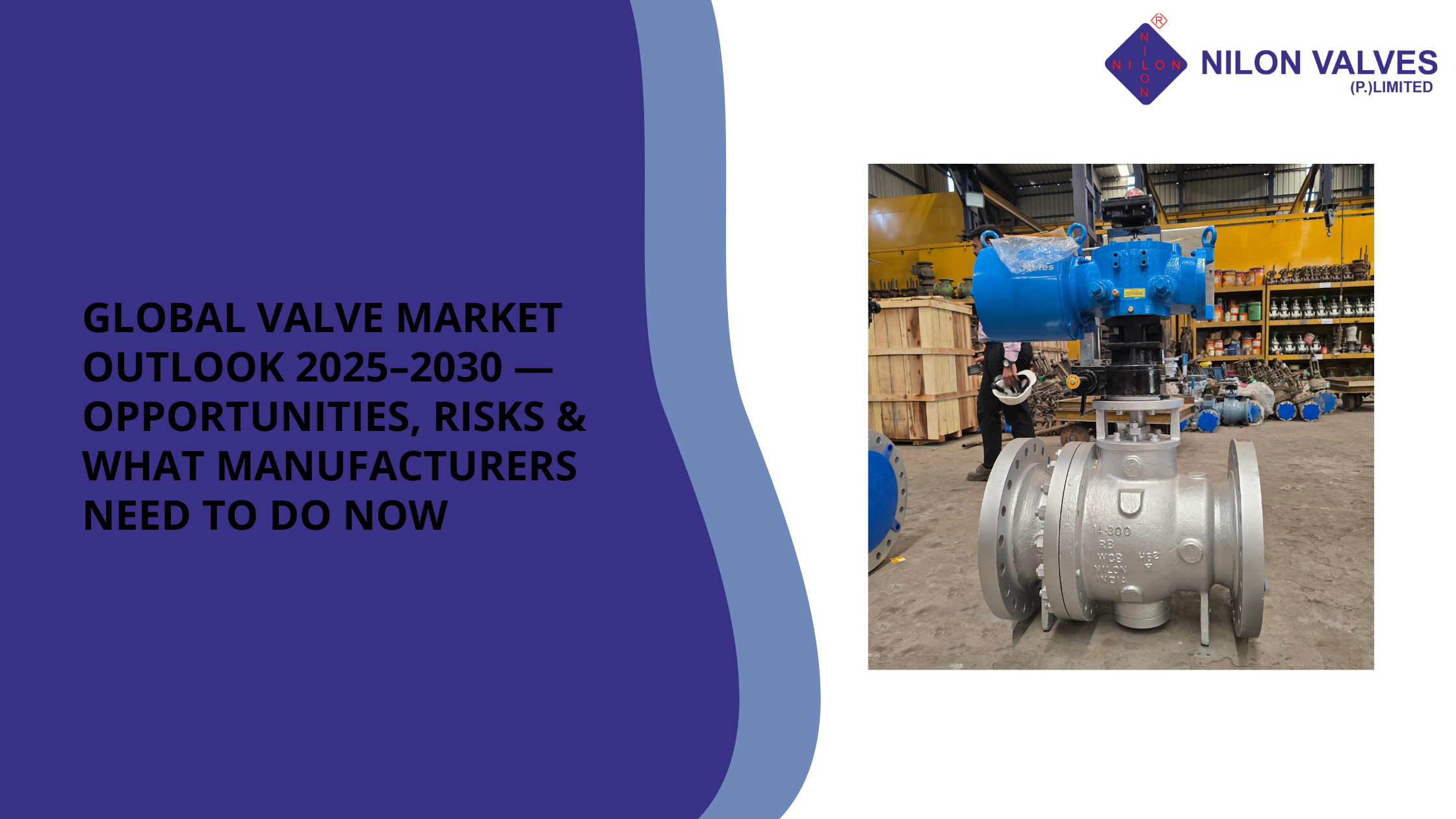
The global valves market is poised for steady growth through 2030, driven by industrial automation, infrastructure spending (water, power, oil & gas), and the emergence of new energy vectors such as hydrogen. Estimates vary by report, but most place the market value in the mid-tens of billions today with a mid-single-digit CAGR through 2030 — and faster growth for specialized segments (e.g., hydrogen, HVAC, smart/control valves). Valve Manufacturers that invest in digitalization (smart valves & IIoT), high-performance materials, aftermarket/service capabilities, and regional supply strength.
- Market size & headline forecasts
Different market research houses use different segmentation and base years, but the consensus is the same: the valve market is large (tens of billions USD) and will grow steadily through 2030.
One recent estimate pegs the global valves market at about USD 84.9 billion in 2025 and projects it to reach ≈USD 115.5 billion by 2030 (≈6.3% CAGR 2025–2030).
Other respected reports place the market in a similar ballpark (for example, valuations around USD 76–86 billion in the early 2020s) and forecast CAGRs in the 4–6% range to 2030 depending on scope (industrial valves, control valves, HVAC, etc.).
2. Segments to watch (where growth exceeds the baseline)
Hydrogen & clean-energy valves
Hydrogen infrastructure and green-hydrogen projects are creating a new demand stream for purpose-designed valves (materials, sealing solutions, leak prevention). Specialist market studies show hydrogen valves as a fast-growing subset, with multiple reports indicating high double-digit or high single-digit growth for hydrogen valve products depending on the time horizon and base year.
Control / smart valves & IIoT
The push toward plant automation and predictive maintenance is lifting demand for control and “smart” valves with integrated sensing, diagnostics, and communications. Control valves are being upgraded with digital positioners, condition monitoring, and connectivity to asset-management platforms — a value stream that increases aftermarket revenue and customer lock-in. Market forecasts project steady growth for control valves as a segment.
HVAC & building systems valves
With rising construction activity (particularly in Asia and MENA), the HVAC valve market is expanding quickly. Reports show HVAC valves growing faster than many other valve types due to retrofits, energy efficiency upgrades, and new construction.
3. Regional outlook — where demand is concentrated
Asia-Pacific continues to dominate global valve consumption thanks to large industrial projects, petrochemical capacity expansion, power generation, and massive water/wastewater infrastructure programs. The region also leads in valve manufacturing capacity, which affects pricing and global supply chains.
North America and Europe show solid demand driven by energy sector investments, refinery/upgrading projects, and a transition to cleaner fuels; Europe in particular is a strategic market for hydrogen and energy transition-related valve demand.
4. Key demand drivers (what’s pushing growth)
- Industrial automation & predictive maintenance. Plants want lower downtime and better process control — smart valves reduce trips and maintenance costs.
- Energy transition & hydrogen adoption. New projects for hydrogen production, storage, and distribution require H2-compatible valves
- Infrastructure spend (water/wastewater, desalination, power, chemical plants) — large CAPEX projects use large volumes of valves, often with higher specifications.
5. Challenges & headwinds
- Cyclicality of oil & gas: A significant slice of valve demand tracks hydrocarbon capex cycles — downturns can depress orders for high-spec valves.
- Supply chain & raw-material price volatility: Metals and specialty materials affect margins and lead times.
- Fragmented market & pricing pressure: Many regional players make price competition fierce for commodity valves; differentiation is critical.
- Technical standards & certification complexity: Meeting hydrogen, cryogenic, or nuclear standards demands investment in testing and quality systems.
6. Competitive landscape & business models
- OEMs (global and regional): Large multinationals supply complex, certified valves for oil, gas, petrochemical, and power sectors. They compete on technology, brand, and certification.
- Regional specialists: Fast to market on local projects, competitive on price, often dominate commodity/standard valve segments.
- Aftermarket & service providers: Valve servicing, rehabilitation, retrofitting with smart positioners, and spare parts are high-margin recurring revenue streams.
- New entrants (startups) & system integrators: Focus on smart actuators, digital diagnostics, or specialized materials for hydrogen/low-temperature.
7. Practical recommendations for valve manufacturers (how to win 2025–2030)
- Invest in smart valves and IIoT: Add digital positioners, condition monitoring, and cloud integration to products. This increases lifetime customer value through services and analytics.
- Target hydrogen & low-temperature niches early: Obtain relevant certifications, run hydrogen embrittlement tests, and design seals and materials for H2 service. Early movers will command premium pricing
- Build aftermarket & field service capability: Create regional service hubs, offer retrofits, predictive maintenance contracts, and spare-parts programs — recurring revenue reduces exposure to CAPEX cycles.
- Regional production + local inventory: Keep manufacturing or assembly capacity close to large demand centres (APAC, Middle East, North America) to shorten lead times and meet procurement preferences
- Focus R&D on advanced materials & energy efficiency: Lighter, corrosion-resistant alloys, improved sealing materials, and designs that minimize pressure drop are commercially valuable.
- Emphasize certifications & quality systems: ISO, API, PED/CE, and hydrogen-specific standards will win bids for critical projects.
8. Go-to-market: product & sales playbook
- Tiered portfolio: Standard valves (cost-competitive), engineered valves (project bids), and smart valves (value-added/recurring).
- Channel strategy: Direct sales for large EPCs; distributors and local partners for service and spare parts.
- Digital offerings: Condition monitoring dashboards, predictive-maintenance subscriptions, and remote diagnostics — bundle hardware + SaaS for sticky revenue.
9. Risks to monitor (2025–2030)
- Geopolitical shocks & trade restrictions that affect raw materials or exports.
- Rapid shifts in energy policy that could either accelerate hydrogen adoption or slow certain fossil-fuel projects (affecting valve demand).
- Technological disruption — if competitors successfully commoditize smart valves, margins could compress.
10. Conclusion
From 2025 to 2030 the valve market is not about a single breakout boom — it’s a tale of steady baseline demand with pockets of acceleration. Ball valve Manufa
cturers, Butterfly valves manufacturer who treat the market as segmented — investing selectively in high-growth niches (hydrogen, smart/control, HVAC), building aftermarket and service excellence, and aligning production footprints to the Asia-Pacific and regional project clusters — will capture above-market returns. Commodity suppliers who ignore digitalization or service margins risk being squeezed on price and profitability.
Here you can check out: Industrial Valve Manufacturer & Exporter USA
Frequently Asked Questions (FAQs)
1. What is the projected growth of the global valve market between 2025–2030?
The global valve market is expected to witness steady growth, driven by increased demand in oil & gas, water treatment, power generation, and manufacturing industries. Technological innovations like smart valves and predictive maintenance solutions are expected to accelerate this growth.
2. Which industries will drive the majority of valve demand during this period?
Key demand will come from oil & gas, chemical processing, pharmaceuticals, food & beverage, water treatment, and power generation sectors. The rise in renewable energy and smart infrastructure projects will also create new opportunities for valve manufacturers.
3. What are the major risks valve manufacturers face in 2025–2030?
The biggest risks include supply chain disruptions, fluctuating raw material prices, tightening global regulations, and increased competition from low-cost manufacturers. Companies must also prepare for digital transformation and adopt IoT-enabled solutions to stay relevant.
